One-day Rome — Artist's Spring Sketch & Studio Day
A relaxed, art-focused day in Rome for painters and makers: morning plein-air sketching with classical views, a visit to a historic sculptor's atelier, a local studio hub and a hands-on photographic/print collective, plus time to scout materials and capture sunset over the city. March (spring) brings cool, changeable light — layers and a compact umbrella advised.
Highlights
- Plein-air sketching on the Capitoline Hill overlooking the Roman Forum
- Museo Atelier Canova Tadolini — a historic sculptor's working studio
- Pastificio Cerere — an active artist studio complex
- Hands-on session at Officine Fotografiche Roma
- Sunset vistas from the Gianicolo (Janiculum) for plein-air painting
Explore all itineraries in Rome.
Itinerary
Day 1
A full artistic day balanced between outdoor sketching, small ateliers, practical workshops and relaxed meals — paced for March daylight and cooler weather.
Plein-air sketch: Piazza del Campidoglio (Capitoline Hill) overlooking the Forum
Begin with morning light on the Roman Forum from the terraces of the Capitoline Hill — a classic composition study for figure, architecture and atmospheric perspective.
Tips from local experts:
- Set up on the terrace near the Cordonata steps (stone benches make comfortable low seats); the morning light (09:00–10:30) gives soft glancing shadows good for tonal sketches.
- March can be breezy and cool — bring a lightweight clip-on board or small easel and a compact umbrella (quick gusts are common).
- If you need charcoal or a quick coffee, walk down to Via di San Pietro in Carcere (5 min) where small cafés and a newsstand sell sketch pads and bottled warmth.
Transfer: Walk to Museo Atelier Canova Tadolini
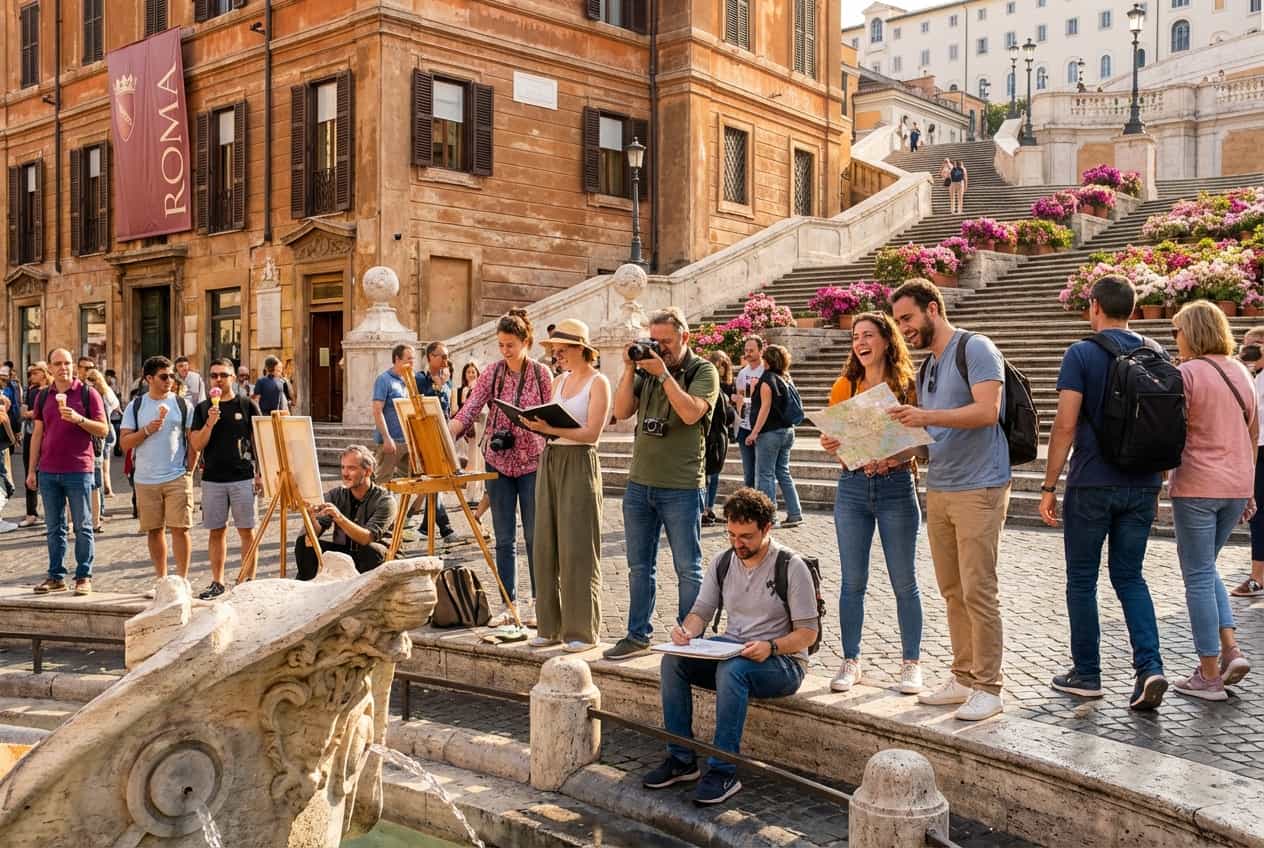
Short walk across the historic center to the sculptor's atelier-museum near the Spanish Steps.
Tips from local experts:
- Take the scenic route via Via dei Fori Imperiali then cut through Largo di Torre Argentina to keep visual references for later sketches.
- If you want to photograph reference angles, stop briefly at Via del Babuino for a composition shot; light changes quickly in March so capture references now.
- There are public restrooms near Largo di Torre Argentina if you need to warm up before the museum visit.
Visit Museo Atelier Canova Tadolini (atelier of sculptors)
Explore the working spaces, plaster casts and original sculptures in the intimate atelier-museum — excellent for sculptural studies and observation of historical studio techniques.
- Monday8:00 AM – 11:00 PM
- Tuesday8:00 AM – 11:00 PM
- Wednesday8:00 AM – 11:00 PM
- Thursday8:00 AM – 11:00 PM
- Friday8:00 AM – 11:00 PM
- Saturday8:00 AM – 11:00 PM
- Sunday10:00 AM – 11:00 PM
Tips from local experts:
- Study the plaster casts and drapery under subdued gallery lighting — great for tonal practice if outdoor light is too harsh.
- Ask the attendant about any artist talks or the possibility to photograph details for later studio work (museum staff are often accommodating to serious students of sculpture).
- March mornings are quieter — use this timing to sketch small compositional studies of busts; bring a soft pencil (4B–6B) for quick tonal work.
Transfer: Walk to Monti / Ai Tre Scalini for lunch
Walk through the Navona/Campo de' Fiori area toward Monti — a short transfer with plenty of windows and shops to inspire sketches.
Tips from local experts:
- Grab a quick street-side photo for color reference; mid-March light suits warm tonal palettes.
- If you want to pick up a sketching snack, stop at small food stalls around Campo de' Fiori for seasonal produce to energize the afternoon.
- Watch for cobbled streets near Monti — wear shoes suitable for standing while you sketch outside at lunch.
Lunch at Ai Tre Scalini (Monti) — long, relaxed meal
A classic Monti wine bar beloved by locals and creatives: enjoy seasonal Roman small plates, house charcuterie and a relaxed atmosphere to review morning sketches.
- Monday12:00 PM – 12:00 AM
- Tuesday12:00 PM – 12:00 AM
- Wednesday12:00 PM – 12:00 AM
- Thursday12:00 PM – 12:00 AM
- Friday12:00 PM – 12:00 AM
- Saturday12:00 PM – 12:00 AM
- Sunday12:00 PM – 12:00 AM
Tips from local experts:
- Ask the staff for a window seat or a corner with good light to continue thumbnail sketching while you eat.
- Order seasonal items (March often brings early artichokes or asparagus) — good for still-life color studies.
- There is limited indoor space; if you prefer to sketch outside, the adjacent Via Panisperna has quieter spots for drawing between bites.
Transfer: Travel to Pastificio Cerere (artist studio complex)
Head to the artist-run complex where contemporary Roman artists have studios — a chance to see working rooms and street-scale murals.
Tips from local experts:
- Take public transport or a short taxi — ask the driver for 'Pastificio Cerere' in the destination neighborhood to avoid confusion.
- Carry a small portfolio if you hope to introduce yourself to resident artists; March afternoons are friendly for studio visits.
- If it's drizzling (possible in March), tuck sketchbooks inside a waterproof sleeve before leaving Monti.
Studio visit: Pastificio Cerere — artist hub and murals
Walk the complex of converted factory studios, meet local artists if they’re available, and study mural and mixed-media works in progress.
- MondayClosed
- Tuesday3:00 – 7:00 PM
- Wednesday3:00 – 7:00 PM
- Thursday3:00 – 7:00 PM
- Friday3:00 – 7:00 PM
- SaturdayClosed
- SundayClosed
Tips from local experts:
- Respect working hours and ask before photographing inside studios — many artists will gladly share process tips if approached politely.
- Look for nearby shops selling secondhand frames and stretcher bars; local artists often post flyers for materials swaps on studio doors.
- Use the complex courtyards for quick plein-air sketches of industrial textures and mural details — great reference for mixed-media work.
Transfer: Short trip to Officine Fotografiche Roma
Move to the photography collective for an afternoon practical session or tour of exhibitions and darkroom/printing facilities.
Tips from local experts:
- Use a taxi or short metro ride; if carrying wet paintings or canvases, a taxi is quicker and protects work from March showers.
- Call ahead to confirm drop-in workshop times — some sessions require registration, especially in shoulder season.
- If you need to top up art supplies, ask studio artists in Pastificio Cerere for local supplier recommendations en route.
Hands-on visit or mini-workshop at Officine Fotografiche Roma
Engage with a photographer-led printing/demo session or explore current exhibitions — useful for artists cross-training in composition and tonal control.
- Monday9:30 AM – 1:00 PM, 3:00 – 7:30 PM
- Tuesday9:30 AM – 1:00 PM, 3:00 – 7:30 PM
- Wednesday9:30 AM – 1:00 PM, 3:00 – 7:30 PM
- Thursday9:30 AM – 1:00 PM, 3:00 – 7:30 PM
- Friday9:30 AM – 1:00 PM, 3:00 – 7:30 PM
- Saturday10:00 AM – 12:30 PM
- SundayClosed
Tips from local experts:
- Bring contrast sketches or reference photos — the staff can advise on translating them into black-and-white tonal studies.
- If you’re interested in cyanotype or alternative processes, ask about seasonal workshops (March often has small weekend classes).
- Pack gloves and a small notebook — demonstrations often involve handling prints and materials you’ll want to note for studio experiments.
Transfer: Move to Gianicolo (Janiculum) for sunset
Head uphill to one of Rome’s best panoramic points — ideal for late-afternoon color studies and a panoramic plein-air session.
Tips from local experts:
- Allow extra time in March as sunsets shift earlier; aim to arrive 30–45 minutes before sunset for golden-hour light.
- A short bus or taxi is easiest — walking uphill with gear is possible but brisk; pack a stool rather than a full easel if you plan to climb.
- There are sheltered spots near the Fontana dell'Acqua Paola; use them if a light spring shower appears.
Sunset plein-air: Belvedere del Gianicolo (Janiculum)
Capture sweeping dusk light across Rome — perfect for atmospheric studies, skyline silhouettes and rapid color blocking.
Tips from local experts:
- Set up facing St. Peter’s dome and the cityscape — the warm low light in March lasts a shorter window, so prepare materials beforehand.
- Bring a thermos or a warm drink; March evenings can get chilly quickly as the sun sets behind the city.
- Use intermittent quick washes or toned-paper sketches to lock in values quickly; wind can pick up, so clip paper securely.
Transfer: Descend to central Trastevere / Campo de' Fiori area for dinner
A pleasant descent into lively neighborhoods where local restaurants and artists gather for evening conversation.
Tips from local experts:
- Taxi or tram is recommended after sunset for convenience with wet canvases; walking routes are scenic but may be slick on cobbles.
- If you picked up reference photos at Gianicolo, now is a good time to sort and label them before dinner.
- Keep an eye on hours — some artist-frequented osterie close early in low season; this timing avoids the dinner rush.
Dinner at Osteria da Fortunata (handmade pasta, artist-friendly ambiance)
Enjoy handmade pasta and traditional Roman dishes in a focused, craft-oriented kitchen — a satisfying end to a creative day.
- Monday11:30 AM – 12:30 AM
- Tuesday11:30 AM – 12:30 AM
- Wednesday11:30 AM – 12:30 AM
- Thursday11:30 AM – 12:30 AM
- Friday11:30 AM – 12:30 AM
- Saturday11:30 AM – 12:30 AM
- Sunday11:30 AM – 12:30 AM
Tips from local experts:
- Request a table near the open pasta area if available — watching the craft of pasta-making resonates with studio practice.
- Share a couple of small plates to free up time and appetite for a post-dinner sketching walk in Trastevere.
- March menus highlight early spring vegetables — note colors and textures for still-life studies the next day.
Evening sketch/stroll: Piazza Trilussa, Trastevere (night life + people study)
Finish with relaxed figure and nocturnal light studies in a classic Trastevere piazza — warm lamplight and lively street scenes offer gesture drawing opportunities.
Tips from local experts:
- Focus on quick gesture sketches of passersby and café scenes — low light is perfect for value studies with charcoal or soft pencils.
- If it’s colder, stand near a café window to draw inside scenes; many bars in Trastevere have characterful interiors ideal for reference photos.
- Be mindful of your belongings; pocket-sized sketchbooks are easier to manage in lively evening crowds.
Itinerary Attributes
| Days | 1 |
| Highlights | 5 |
| Season | Spring |
| Month | March |
| Persona | Artists |
| Transfers | 6 |
| Restaurants | 2 |
| Total Activities | 8 |
| Total Places | 8 |
| Activities Types | Outdoor, Transfer, Culture, Meal, Experience, Neighborhood |
Why this experience
One spring day for artists, sketchers, and creatives. You'll visit artist neighborhoods like Monti with hidden studios, explore small galleries and artisan workshops, sketch in quiet piazzas with Rome's architecture as your subject, take a guided tour of artist-favorite locations, visit museum collections with a focus on technique and composition, and end with café time to share your work and discuss what you've seen. Rome is an artist's muse—this itinerary treats it that way.
Before you go
- Best time: Spring (March–May). Natural light is perfect for sketching, weather is mild, gardens are in bloom.
- Budget: Check the booking widget for current pricing. Includes guided studio tours, museum entries (artist-focused), meals, and materials if needed.
- Difficulty: Easy. Mostly walking between neighborhoods, sitting and sketching, no strenuous climbing.
- What to bring: Sketchbook and pencils/paints, comfortable walking shoes, hat, sunscreen, water, small backpack.
- Getting there: Meet in Monti neighborhood or your hotel. Metro easily accessible.
- Accessibility: Neighborhoods have stairs; museums are accessible. Discuss needs when booking.
Frequently asked questions
Do I need to be a trained artist to join? No. All skill levels welcome. This itinerary celebrates observation and creativity, not perfection.
Can I use digital tools (iPad, stylus) instead of traditional sketch materials? Yes, absolutely. The focus is observation and expression in whatever medium works for you.
Are there organized workshops or just self-directed sketching? Mix of both. Some guided studio visits, some open sketch time in piazzas. Flexibility is built in.
Can we visit artist markets or buy local work? Yes. Monti and Trastevere have weekend markets with local artists. Guided stops can include gallery visits and artisan studios.
Complete your trip in Rome
Pair with other creative experiences or extend your stay:
- Artists, 1 day (alt) — Alternative artist-focused itinerary
- Cultural, multi-day — Architecture-focused walking tour
- Food + Arts, 1 day — Combine art exploration with food culture
Browse all Rome itineraries at TheNextGuide.
Last updated: March 2026