Shanghai Travel Guides
You step out of the metro at Nanjing Road and the city hits you all at once — neon signs stacked ten storeys high, the smell of scallion pancakes frying on a cart, a grandmother doing tai chi in the shadow of the Shanghai Tower. Walk three blocks east and you're on the Bund, staring across the Huangpu at a skyline that didn't exist thirty years ago. Walk three blocks west and you're in a lane house neighbourhood where laundry dries between walls built in the 1930s. Shanghai doesn't blend old and new — it stacks them on top of each other and dares you to make sense of it.
Browse Shanghai itineraries by how you travel.
Shanghai by travel style
The way you travel changes what Shanghai shows you. A guided day with a local opens doors — literally, in some temples — that you'd walk past on your own. Self-guided wandering rewards you with lane house neighbourhoods, wet markets, and the kind of street food encounters that never make it into guidebooks. Here's how different travellers tend to get the most from this city.
For couples
Shanghai is romance in unexpected places. The classical gardens speak a quiet language of balance and beauty — stepping into The Humble Administrator's Garden with someone you love changes how you see water, stone, and space. A river cruise at dusk, when the city lights begin to mirror themselves in the Huangpu, creates a moment of pause in the energy of the city. Shantang Street in Suzhou, where locals still hang laundry between centuries-old buildings, feels intimate in a way major tourist sites often don't. Many couples find that a full-day guided tour — to Suzhou or through Shanghai's cultural landmarks — lets you focus on each other while someone else handles logistics.
For solo travellers
Solo in Shanghai means you move at your own rhythm. You might spend an afternoon in a garden without worrying about anyone else's pace, or sit in a street-side restaurant and watch the city without having to explain what you're observing. The river cruise is a natural solo experience — you see the whole city from one vantage point, no navigation required. Many solo travellers book a full-day tour not because they need hand-holding, but because it's efficient; you get context, entry logistics, and transport all handled so you can spend your mental energy on what you're actually seeing.
For families
Shanghai is more family-friendly than most people expect. Yu Garden is compact enough that younger kids won't lose interest — the koi ponds and rockeries hold attention better than any museum. The full-day cultural tour works well for families because the guide handles logistics (tickets, transport, timing), which means you're not wrestling with maps while managing a seven-year-old. The Huangpu river cruise gives everyone a break from walking, and kids love watching the barges. For older children, the Shanghai Science and Technology Museum in Pudong is genuinely good — interactive, well-designed, and big enough for a full morning. Eating with kids is easy here: xiaolongbao are fun to eat, noodle shops are fast, and most restaurants are used to families.
For friends
Shanghai is a group city — it rewards shared experience. Split up during the day and compare notes over dinner. One of you goes to M50 Art District, another wanders the French Concession, someone else takes the Suzhou day trip. Then you meet at a restaurant on Wujiang Road and the conversation writes itself. Nights in Shanghai suit groups: craft beer at Boxing Cat Brewery, cocktails in the French Concession, late-night street food on Yunnan Road. The city's scale means you never feel like you're on top of each other, even when you're travelling together.
For food lovers
Shanghai cuisine is its own dialect — sweeter, oilier, and more soy-heavy than Cantonese or Sichuan cooking. The city's signature is xiaolongbao (soup dumplings), and the difference between a good one and a great one is worth understanding. Nanxiang Steamed Bun Restaurant in Huangpu does thousands a day; the skin is thin enough to see the broth inside. Red-braised pork (hong shao rou) is the other defining dish — slow-cooked until the fat dissolves and the sauce turns glossy and dark. Beyond Shanghainese food, the city is a compendium of every regional Chinese cuisine: Sichuan mapo tofu at Lucapps in Changning, Yunnan noodles on Yunnan Road Food Street, Cantonese dim sum at T'ang Court or Yi Long Court. The French Concession adds a layer of international food that's genuinely good, not tourist-grade — natural wine bars, Italian small plates, proper bistro cooking. Eat where you see a queue forming; in Shanghai, the queue is the review.
For photographers
Shanghai gives you two cities in one frame. Stand on the Bund at 6:30 AM and shoot east: the Pudong skyline reflects off the river with no crowds in the foreground. Cross the river and shoot west: the colonial-era buildings glow warm in late afternoon light. The French Concession's tree-lined streets are best in autumn, when plane tree leaves filter the light into soft patterns on the pavement. For street photography, Huangpu's older lanes deliver — residents going about their morning, wet markets, bicycles parked against crumbling walls. Tianzifang is photogenic but crowded; go on a weekday morning. M50 Art District has raw industrial textures and changing exhibitions. The contrast between Pudong's glass towers and Huangpu's low-rise lanes is a story most travel photographers miss because they stay on the Bund.
For mindful travellers
Shanghai is louder and faster than most cities, which makes its quiet spaces feel earned. Jade Buddha Temple is a functioning monastery — arrive early, before the tour groups, and you'll hear monks chanting in a courtyard where incense smoke curls through the air. Longhua Temple is older and less visited; the grounds are large enough to walk slowly. Yu Garden was designed for contemplation — every window frames a different composition, every turn reveals a new balance of stone, water, and green. If you need space from the city, the day trip to Suzhou takes you to gardens that were built specifically for meditation and retreat. Back in Shanghai, Century Park in Pudong is 140 hectares of green — enough to forget you're in a city of 25 million.
How many days do you need in Shanghai?
1 day in Shanghai
If you have only a day, make it count with a full-day guided tour. You could do Yu Garden, Jade Buddha Temple, and the river cruise to capture Shanghai's spiritual and historical heart, or take the day trip to Suzhou to experience classical Chinese garden culture at its source. Either option gives you a coherent narrative — not a list of sights, but a story. The guide does the heavy lifting; you experience, learn, and rest when needed.
2 days in Shanghai
Two days lets you do a full-day tour and still have breathing room. You might dedicate one day to cultural landmarks and use your second day to wander a neighbourhood like The Bund (colonial architecture and river views), Jing'an (contemporary Shanghai), or Huangpu (older residential Shanghai). Two days also gives you a chance to eat intentionally — rather than grabbing meals around a tour schedule.
3 days in Shanghai
Three days is the minimum for actually knowing Shanghai. Do a full-day tour in the city or outside it, then use your other two days to explore different neighbourhoods, sit in cafes, visit museums at your own pace, and eat where locals eat. You'll start to recognize patterns in how the city is organized, and you'll have moments of genuine solitude.
4+ days in Shanghai
Four or more days means you're not just visiting — you're settling. You can do a guided tour without feeling rushed, spend full days in different neighbourhoods, take cooking classes or art workshops, visit museums thoroughly, and have extended conversations with people you meet. You might take a day trip to Suzhou and still have time to explore Shanghai's own depths.
Bookable experiences in Shanghai
We partner with experienced local operators who run these guided tours. Each one is designed to be coherent — you're not collecting checkmarks, you're building understanding.
- Full-day cultural tours: Yu Garden, Jade Buddha Temple, and river cruise, or day trip to Suzhou's gardens and Grand Canal. Both include transport, entry, and a guide.
- Private tours for groups or couples: All our operators offer private group experiences — you set the size and pace. Families, friend groups, or couples can book through TheNextGuide.
Where to eat in Shanghai
The Bund and Huangpu District
The Bund is the obvious choice for river views, and it can feel touristy, but the food ranges from casual to high-end. M on the Bund is the classic upscale option — French-influenced, expensive, and the terrace looks straight at the skyline. If you want views without the price tag, walk into the colonial buildings themselves; many have smaller restaurants with less traffic. Xinchang Restaurant serves classic Shanghai cuisine in a building that hasn't changed much in decades — pork buns, shrimp, whole fish prepared the Shanghai way. 8½ Otto e Mezzo Bombana is Michelin-starred Italian with a river view; book ahead if you want dinner. For casual eating, the streets behind the Bund have steamed bun shops and noodle stands that locals use.
Jing'an District
Jing'an is where young Shanghai eats and drinks. Ultraviolet by Paul Pairet is experimental and theatrical — the chef writes the menu on your skin (metaphorically), and it's an event more than a meal. T'ang Court in the Langham does dim sum that rivals Hong Kong. Boxing Cat Brewery is an American-style craft beer bar with solid burgers and a young crowd. Lao Ban Soy Sauce Chicken Rice is exactly what it sounds like — a stall-style restaurant where chicken is cooked over charcoal and served over rice soaked in soy sauce; locals queue for this. Dumplings & Co. does handmade dumplings and xiaolongbao (soup dumplings) with high technique and low prices.
Huangpu District
The older Shanghai lives here, and so does its food. Da Hu Lou serves dishes from the Chinese countryside — not Shanghai cuisine, but flavours you won't find in restaurants aimed at foreigners. Yi Long Court is dim sum in a heritage building; go early to avoid crowds. Old Shanghai Noodles pulls hand-stretched noodles in front of you and serves them in a broth that tastes like it's been simmering since 1970. Nanxiang Steamed Bun Restaurant is famous for xiaolongbao — they do thousands a day, which means they're always fresh. Green Tea Restaurant is Michelin-listed vegetarian; if you eat meat, it's a chance to experience what Shanghai cuisine looks like without animal protein. Shookee does Southeast Asian street food (Vietnamese, Thai, Filipino) in a neighbourhood that was once home to migrant workers.
French Concession
The French Concession is leafy and walkable, and the food reflects its expat history. The Commune Social is casual Italian-Spanish with natural wine; it's a place to linger over a meal. La Cantine du Faubourg does bistro food in a space that feels genuinely Parisian (mostly because many of the staff are). Barbara is a wine bar and small-plates spot that's become a local landmark; it's always crowded, but the energy is infectious. Carbone brought the New York Italian-American vibe to Shanghai, and somehow it works. Jianguo Road Food Street is a series of small restaurants and stalls concentrated on one block — go here to try multiple things cheaply. Teddy's Fried Chicken has nothing to do with the Concession's history, but it's become an institution; people queue for the fried chicken sandwiches.
Changning District
Changning is residential and quieter. All Set does Southern American food (biscuits, fried chicken, low-country cuisine) in a neighbourhood most tourists never see. Katharina's Vegan Kitchen is vegan German food, which sounds impossible but works; the space is warm and intimate. Lucapps is a casual Sichuan restaurant that locals know about but don't advertise; the mapo tofu is properly numbing and hot.
Food markets and street eating
Wujiang Road Food Street is a compressed version of Shanghai's street food scene — small stalls selling noodles, buns, skewers, and snacks. Go mid-morning or late afternoon (not peak hours). City God Temple Market sells everything from fresh produce to ready-to-eat food; it's chaotic and worth wandering. Jing'an Temple Food Court is an underground mall of food vendors — cheap, fast, authentic. Yunnan Road Food Street focuses on regional Chinese cuisines from Yunnan Province and beyond.
Shanghai neighbourhoods in depth
The Bund
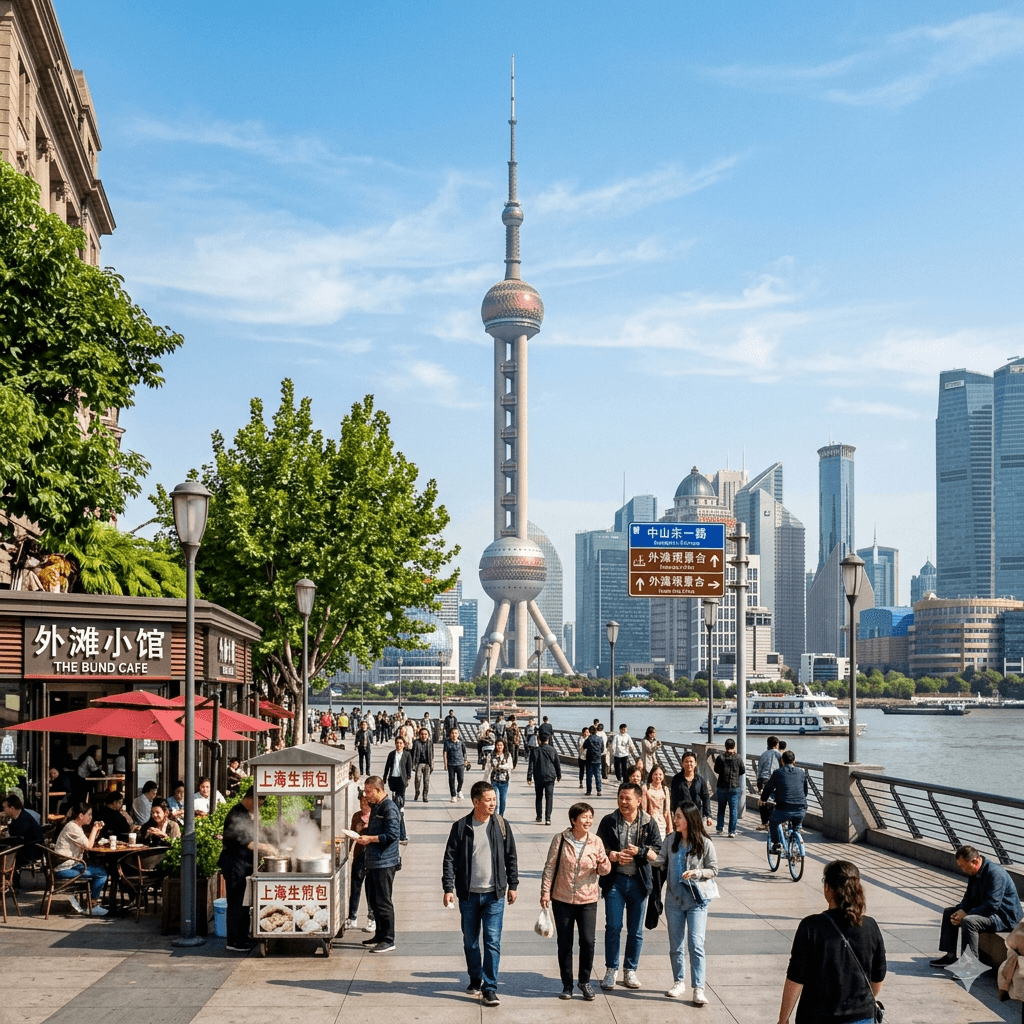
The Bund is Shanghai's front door to the world — a long promenade of colonial-era buildings facing the Huangpu River and Pudong's gleaming towers on the opposite bank. It's impossible to ignore and worth understanding. Walk it at different times: dawn when joggers outnumber tourists, midday when it's shoulder-to-shoulder, dusk when the light turns gold. The older buildings have stories — British banks, trading houses, customs buildings, all now restaurants, hotels, and shops. The stretch from Nanjing Road to Yan'an Road is the most crowded and most photographed. If you want the Bund experience with fewer people, walk from Yan'an Road north toward Suzhou Creek; it opens up and feels more like a working riverfront. The best time to go is late afternoon, when the light is warm and the evening crowd hasn't arrived yet. The full-day cultural tour includes a Huangpu river cruise that gives you the Bund from the water — a completely different perspective.
Jing'an District
Jing'an is contemporary Shanghai — where young people live, eat, and build their lives. Jing'an Temple sits at the centre, a functioning Buddhist temple surrounded by luxury malls and trendy restaurants. It's a strange mix, but it works. Walk south from the temple toward Wujiang Road, and you'll find a compressed version of Shanghai's food and shopping culture. Jing'an is best explored on foot, stopping when something catches your attention. The streets are wide and walkable, and the energy is higher than many other districts. Spring and autumn are ideal; you can wander for hours without getting too hot.
Huangpu District
This is old Shanghai — narrow streets, low buildings, residents who've lived here for generations. It's where you feel the weight of Shanghai's history. The neighbourhood around People's Square is more touristy, but south of Nanjing Road, the streets belong to locals. Walk Henan Road, Yunnan Road, or Xiandai Road and you'll see how Shanghai residents actually live. Small restaurants, wet markets, laundry strung between buildings, children playing. It's a glimpse of Shanghai before skyscrapers. Go early in the morning or late afternoon; midday can feel empty because people are indoors escaping the heat. Yu Garden sits in this district — if you're exploring on your own, combine it with the surrounding bazaar streets; if you want context, the guided cultural tour starts here.
French Concession
The French Concession is the most walkable neighbourhood in Shanghai. Wide tree-lined streets, colonial villas converted into cafes and shops, a sense of pace and attention. It's popular with expats and visitors, but the popularity hasn't destroyed it — there's still room to wander. Rent a bike or walk Huaihai Road, the main spine, then turn into side streets. Jing'an Road is quieter and has better colonial architecture. The neighbourhood is at its best in late afternoon, when the light is soft and the cafes start to fill. Spring and autumn are perfect; summer is hot, winter is cold but manageable.
Pudong
Pudong is the future Shanghai — a forest of towers, wide streets, gleaming surfaces. The Oriental Pearl Tower, the Shanghai Tower, the financial district — it's all here. Pudong is best experienced from across the river (from the Bund) or from within a building looking out. Walking Pudong can feel disorienting because the scale is enormous and the neighbourhoods blur together. If you're interested in architecture or futurism, spend time here. If you want to experience Shanghai as a human place, spend less time here. The parks (Lujiazui Green Space, Century Park) are pleasant and less crowded than the streets.
Changning District
Changning is residential and quiet — where many expats and long-term residents live. It's less touristy than other districts, which makes it interesting if you want to see how Shanghai actually functions. Wujiang Road is the neighbourhood's main spine, with restaurants and bars. But mostly, Changning is for living, not visiting. If you're staying here for a few days, explore at your own pace. Spring and autumn are best; the tree cover makes it more comfortable than districts with more concrete.
Museums and cultural sites in Shanghai
Start here
Yu Garden is Shanghai's most famous classical Chinese garden — a Ming Dynasty space of water, rock, plants, and buildings designed to evoke nature in miniature. Walk slowly; every viewpoint frames a picture. The garden is crowded, especially mid-morning, so go early or late. Jade Buddha Temple is a functioning Buddhist temple where you can see both the famous jade Buddha and monks at prayer. It's less touristy than Yu Garden and feels more like an actual place of worship. M50 Art District is a converted factory now filled with artist studios and galleries. It's rambling and unorganized, which is part of its charm. You wander, peek into studios, and sometimes talk to artists. Free to explore; galleries may charge for entry.
Go deeper
Shanghai Museum covers Chinese art from ancient times through the Qing Dynasty — ceramics, calligraphy, painting, sculpture. It's well-organized and manageable in a few hours. Power Station of Art is contemporary art in an old power station; the building itself is the first experience. Propaganda Poster Art Centre is smaller and quirky — a collection of Cultural Revolution propaganda, all political and visually striking. Longhua Temple is older than Jade Buddha Temple but less touristed; it's an active monastery in a neighbourhood where life happens around it. Suzhou Museum is technically outside Shanghai, but if you take the day trip to Suzhou, the museum is worth an hour — architecture by I.M. Pei, with collections of classical Chinese art and Suzhou history.
Off the radar
Shanghai History Museum is in the basement of the Oriental Pearl Tower, which is touristy, but the museum itself is thoughtful and less crowded than you'd expect. It covers Shanghai from a fishing village to megacity. Zhujiajiao Water Town is a smaller, older version of Venice — canals, bridges, low buildings. It's about 50 minutes from central Shanghai and less crowded than the city itself. Tianzifang is an artsy neighbourhood in the French Concession with galleries, cafes, and studios. It's become popular, but it's genuine — artists and designers actually work and live here. Wuzhen Water Town is similar to Zhujiajiao but further away and less touristed; it's a longer trip but worth it if you want to experience old Shanghai outside the city.
First-time visitor essentials
What to know
Shanghai is a city of contradictions that somehow work. The traditional and the ultramodern exist in the same block. Subways are efficient and crowded. Traffic is chaotic but somehow organized. Most tourist areas have English signage and speak English; neighbourhoods away from tourism don't. The humidity is real in summer; winters are cold but dry. Shanghai moves fast — locals walk quickly, talk quickly, and assume you know where you're going. If you need help, ask. Most people will. The food is exceptional and cheap if you eat where locals eat. Tipping is not expected, though it's becoming more common in tourist-oriented restaurants. Shanghai is safe; violent crime against tourists is rare.
Common mistakes
Don't assume all Chinese cuisine is the same; Shanghai has its own style (sweet, oily, salty — it's an acquired taste for some). Don't skip the neighbourhoods beyond the Bund — most of Shanghai's character lives in residential areas. Don't eat only at restaurants aimed at tourists; eating at stalls and small restaurants is both cheaper and better. Don't try to see everything; you'll burn out. Pick neighbourhoods or themes and go deep. Don't plan your day minute-by-minute; the best experiences happen when you're lost or wandering. Don't assume you'll be able to read signs; download an offline translation app if you're worried about getting lost.
Safety and scams
Shanghai is safe for solo travellers of any gender. Violent crime is uncommon. Petty theft happens, especially on crowded subways and in tourist areas, but it's not epidemic. Use normal city precautions — don't flash expensive gear, keep bags in front of you on crowded transport, be aware of your surroundings at night. Scams exist but are usually low-level: taxi overcharges, inflated bar tabs, fake tours. Use official taxis (white with a red stripe on the side) or ride-hailing apps like Didi. Agree on prices before getting in unlicensed taxis. If a stranger approaches you with an "art class" or "tea ceremony," assume it's a setup; walk away. Avoid bars that are advertised by people on the street. The metro is safe and reliable; trust it.
Money and tipping
Cash is becoming less important; most places accept mobile payment (Alipay, WeChat Pay). Bring some yuan, but you don't need much. Credit cards work in hotels and upscale restaurants but not always in smaller places. ATMs are everywhere. Tipping is not standard in Shanghai; a small tip is appreciated but not expected. In tourist restaurants, tipping may appear as a suggested line on the credit card machine — you can decline. Haggling is normal in markets but not in stores or restaurants.
Planning your Shanghai trip
Best time to visit
Spring (March–May) is ideal. Temperatures are mild (15–25°C), humidity is low, and everything is blooming. Days are often sunny, nights are cool. Gardens are at their peak. Spring is peak season, which means more tourists and higher prices, but the weather makes it worth it.
Summer (June–August) is hot, humid, and exhausting. Temperatures exceed 30°C, humidity is oppressive, and afternoon thunderstorms are frequent. Everything feels uncomfortable. If you come in summer, stay indoors during the hottest part of the day (noon–4pm), eat at air-conditioned restaurants, and do major activities early or late. Fewer tourists means cheaper prices and easier logistics.
Autumn (September–November) is when Shanghai is at its second best. Temperatures cool down gradually (25°C in September to 15°C by November), humidity drops, and the light is clear. Days are long enough to be productive. Autumn is becoming peak season as people discover how pleasant it is.
Winter (December–February) is cold and sometimes damp, but it's dry and clear. Temperatures hover around 5–10°C. It's not snowing, but it's not pleasant to be outside for hours. Winter is the cheapest season and the least crowded. If you're coming to Shanghai to eat and explore indoors, winter works. If you want to wander gardens and neighbourhoods, skip it.
Getting around
Metro: Shanghai's subway is extensive, cheap, and reliable. Download the Metro Shanghai app for maps and routing. A ride costs 3–8 yuan (less than $2 USD). Single tickets or day passes available. Trains are crowded during rush hours (7–9am, 5–7pm). English signage is standard in tourist areas.
Taxi and ride-hailing: Official taxis are white with a red stripe and have meters. Ride-hailing apps (Didi, like Uber) are more reliable and often cheaper than hailing a taxi on the street. They require a Chinese phone number, but if you have WeChat, you can set it up. Solo travellers often prefer ride-hailing because there's no language barrier.
Walking: Many Shanghai neighbourhoods are walkable. The Bund, Jing'an, French Concession — all are best explored on foot. Wear comfortable shoes. Streets can be crowded and chaotic; stay aware.
Bike: Shared bikes (Mobike, Ofo) are cheap and fun. You need a Chinese phone number to register, but if you have one, they're a great way to move around. Helmets are not provided, and riding is chaotic, but locals do it.
Neighbourhoods briefly
Choose one or two neighbourhoods to base your exploration. The Bund for river views and colonial history. The French Concession for walkable, cafe-filled streets and expat culture. Jing'an for contemporary Shanghai, young energy, and food. Huangpu for old Shanghai and authentic local life. Pudong if you want to see the future and take photos of towers. Most visitors spend time in 2–3 neighbourhoods and can get a genuine sense of the city.
Frequently asked questions about Shanghai
Is 1 day enough to see Shanghai? It depends on what "seeing" means. One full day can give you a coherent experience — a guided tour of cultural landmarks or a day trip outside the city — but not a full understanding of the city. Two days is the realistic minimum for feeling like you've touched Shanghai. Three days is much better.
What's the best time to visit Shanghai? Spring (March–May) and autumn (September–November). Both have mild temperatures, low humidity, and clear skies. Spring is slightly better for gardens and flowers; autumn is slightly better for light and comfort. Summer is hot and humid; winter is cold and damp.
Is Shanghai safe for solo travellers? Yes. Violent crime is rare. Use normal city precautions — be aware on crowded public transport, don't flash expensive gear, avoid areas that feel unsafe at night. The metro is safe and reliable. Solo travellers often find Shanghai easier to navigate than other Chinese cities because English signage is common in tourist areas.
How walkable is Shanghai? Some neighbourhoods are very walkable (French Concession, Jing'an, Huangpu), others less so (Pudong). Most of Shanghai is walkable if you're comfortable with crowds and uneven sidewalks. Wear comfortable shoes.
What should I avoid in Shanghai? Avoid unlicensed taxis (use Didi or official white taxis). Avoid bars advertised by people on the street. Avoid the Bund at peak hours if you don't like crowds (go early morning or late evening). Avoid eating only at tourist restaurants — the best food is in small places where locals eat.
Where should I eat in Shanghai? Eat at stalls, small family restaurants, and markets where locals eat. Neighborhoods like Huangpu and Changning have authentic, cheap food. The French Concession has good restaurants at many price points. Ask your hotel for recommendations or follow locals.
Are the itineraries on TheNextGuide free? Yes — every Shanghai itinerary is free to read in full, including the day-by-day breakdowns and local tips. You only pay if you decide to book a tour through one of our partner operators (like the Yu Garden and river cruise tour or the Suzhou day trip). We earn a commission on bookings, which is what keeps the itineraries free and detailed.
*Last updated: April 2026*