Kyoto Gion Geisha District Walking Tour — The Stories of Geisha (Couples)
A romantic, lantern-lit 2-hour guided walk through Gion that reveals the history and living traditions of Geisha and Maiko. Meet at Ben's Cookies (Shijo), then stroll past iconic sites — the Okuni statue, Minamiza Kabuki theatre, Hanamikoji, Tatsumi Bridge, Gion Corner, and finish beneath the lanterns of Yasaka Shrine.
In Collaboration with Localized Walking & Food Tours. Updated on April 11, 2026.
This itinerary was created in collaboration with Localized Walking & Food Tours, inspired by the tour Kyoto Gion Geisha District Walking Tour - The Stories of Geisha. Please check the tour information during your booking process.
Highlights
- Meet at Ben's Cookies Kyoto Shijo
- Statue of Izumo no Okuni
- Minamiza (historic kabuki theatre)
- Stroll Hanamikoji (traditional Gion street)
- Tatsumi Bridge (Shirakawa canal views)
- Gion Corner cultural performance house
- Yasaka Shrine lantern-lit finish
Explore all itineraries in Kyoto.
Itinerary
Day 1
Evening 2‑hour guided walking tour for couples through Gion (meet at Ben's Cookies Kyoto Shijo). This March evening tour makes the most of spring evenings — Gion's lanterns, quieter streets and cherry-blossom hints where present.
Meet: Ben's Cookies Kyoto Shijo — Group check-in
Meet your guide and group outside Ben's Cookies (Shijo). Quick briefing on etiquette when spotting Geisha/Maiko and a short opportunity for a warm cookie to share before you begin.
- Monday11:00 AM – 9:00 PM
- Tuesday11:00 AM – 9:00 PM
- Wednesday11:00 AM – 9:00 PM
- Thursday11:00 AM – 9:00 PM
- Friday11:00 AM – 9:00 PM
- Saturday11:00 AM – 9:00 PM
- Sunday11:00 AM – 9:00 PM
Tips from local experts:
- Arrive 10 minutes early so the group can start on time — the meeting point is easy to miss on a busy Shijo street.
- Order a small cookie to share: it's a cozy couple's treat as the guide gives an intro to Gion etiquette.
- Ben's Cookies is step-free at the entrance — keep coats light in March evenings (temperatures can dip).
Stop 1: Statue of Izumo no Okuni — The founder linked to Kabuki
A short guided stop to learn about Izumo no Okuni, who is traditionally credited with founding Kabuki — an intimate moment to connect Kabuki’s theatrical origins to Gion’s streets.
- MondayOpen 24 hours
- TuesdayOpen 24 hours
- WednesdayOpen 24 hours
- ThursdayOpen 24 hours
- FridayOpen 24 hours
- SaturdayOpen 24 hours
- SundayOpen 24 hours
Tips from local experts:
- Stand on the quieter side of the statue for a couple portrait framed by traditional buildings — the guide will point the best angle.
- Ask the guide about Okuni's stories — they make a romantic tale about performance and changing roles in Edo-era Japan.
- Respect the small memorial area: speak softly and avoid climbing on plinths for photos.
Stop 2: Minamiza Theatre — Kabuki’s historic stage in Gion
Exterior visit and story session at Minamiza, one of Japan’s oldest kabuki theatres. Your guide explains kabuki traditions and why this theatre is central to Kyoto’s performing arts.
- Monday10:00 AM – 5:30 PM
- Tuesday10:00 AM – 5:30 PM
- Wednesday10:00 AM – 5:30 PM
- Thursday10:00 AM – 5:30 PM
- Friday10:00 AM – 5:30 PM
- Saturday10:00 AM – 5:30 PM
- Sunday10:00 AM – 5:30 PM
Tips from local experts:
- The theatre façade is beautifully lit at night — perfect for a dramatic couple photo.
- If you’re curious about kabuki performances, ask the guide for recommended seating zones and seasonal schedules.
- There are a few steps at the theatre entrance — hold hands for an easy, romantic step-up if needed.
Stroll: Hanamikoji Street — Timeless Gion architecture
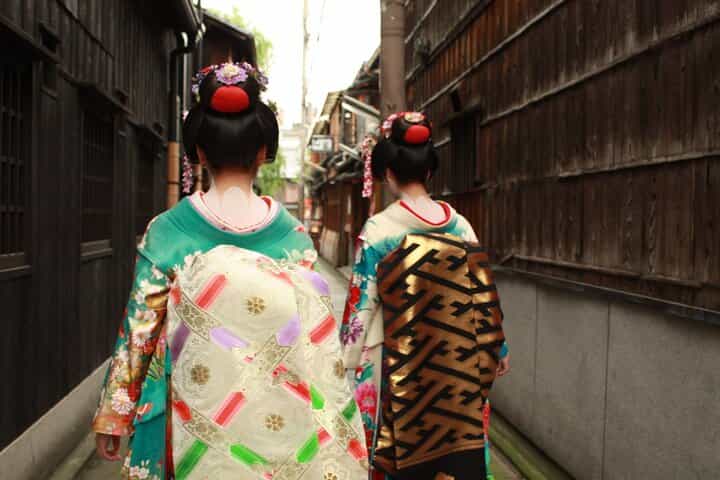
A leisurely walk along Hanamikoji — the quintessential Gion street lined with machiya (wooden townhouses), refined restaurants and teahouses. Your guide points out former teahouse fronts and stories of the geiko/maiko.
Tips from local experts:
- Walk close together and enjoy the lantern-lit atmosphere — this stretch is one of the most romantic in Kyoto after dusk.
- Be considerate: avoid approaching or photographing geiko/maiko aggressively — your guide will advise on respectful viewing.
- Look for narrow side-alleys with traditional latticework for a private photo moment away from crowds.
Viewpoint: Tatsumi Bridge on the Shirakawa Canal
Pause on Tatsumi Bridge for the classic view of the Shirakawa Canal and wooden machiya reflected in the water — a quiet, cinematic spot perfect for a couple’s snapshot.
- MondayOpen 24 hours
- TuesdayOpen 24 hours
- WednesdayOpen 24 hours
- ThursdayOpen 24 hours
- FridayOpen 24 hours
- SaturdayOpen 24 hours
- SundayOpen 24 hours
Tips from local experts:
- Stand toward the middle of the bridge for the widest view; the guide will suggest the best angle for photos and low-light camera settings.
- Listen for the quiet evening sounds — the canal reflections and lantern glow create a naturally intimate setting.
- If it’s breezy in March, keep scarves tucked — the guide can suggest clothing layers for comfort during still moments.
Stop 3: Gion Corner — Quick intro to packaged traditional arts
Exterior and brief explanation of Gion Corner — a place that presents condensed traditional arts performances (tea ceremony, dance, music). The guide explains how these arts connect to Geisha culture.
- Monday5:30 – 8:00 PM
- Tuesday5:30 – 8:00 PM
- Wednesday5:30 – 8:00 PM
- Thursday5:30 – 8:00 PM
- Friday5:30 – 8:00 PM
- Saturday5:30 – 8:00 PM
- Sunday5:30 – 8:00 PM
Tips from local experts:
- If a longer cultural performance interests you, ask the guide about evening showtimes you can book after the tour.
- The façade and lanterns are atmospheric for a close-up couple photo; try a candid shot as you listen to the guide’s anecdotes.
- Seating inside can be low — if you plan to return for a show, request accessible seating or slightly elevated spots.
Finish: Yasaka Shrine — Lantern-lit shrine visit and closing stories
End beneath the glowing lanterns and vermilion gates of Yasaka Shrine. Your guide shares shrine-related festivals (including Gion Matsuri), explains customs, and offers a quiet moment to make a wish together at the ema (wooden wish boards).
- MondayOpen 24 hours
- TuesdayOpen 24 hours
- WednesdayOpen 24 hours
- ThursdayOpen 24 hours
- FridayOpen 24 hours
- SaturdayOpen 24 hours
- SundayOpen 24 hours
Tips from local experts:
- Write a wish together on an ema — a lovely keepsake photo opportunity and intimate ritual to mark the evening.
- The shrine is well lit and open at night in spring; paths are mostly level but there are gentle steps near some structures — the guide will show an easy route.
- After the tour, linger briefly by the shrine approach for a private moment under the lanterns — guides often point out the best, least-crowded vantage spots.
Itinerary Attributes
| Days | 1 |
| Highlights | 7 |
| Season | - |
| Month | - |
| Persona | Couples |
| Transfers | - |
| Restaurants | - |
| Total Activities | 7 |
| Total Places | 7 |
| Activities Types | Shopping, Attraction, Culture, Neighborhood, Outdoor |
Why this experience
You'll walk through Gion, Kyoto's most famous geisha district, with a guide who knows its stories. Not the tourist version—the real history. You'll learn what geiko and maiko actually are, how they train, what their lives entail. You'll walk the narrow lanes where geisha still walk to evening appointments, see the wooden machiya houses that have stood for centuries, and understand the architecture and social customs that define Gion. Your guide will point out the teahouses where performances happen, explain the wooden lattice screens, and share stories of legendary geisha. You might glimpse an actual geisha hurrying to work (though spotting them is never guaranteed). By the end, you'll understand Gion not as a postcard, but as a living, complex community.
This is ideal for couples who want cultural depth without being talked at by a crowd, who appreciate history and human stories, and who want to experience Gion at a pace that lets you absorb details and ask questions.
Before you go
- Best time: Spring and autumn are beautiful in Gion—the light is soft, the weather comfortable. Summer evenings are lively with geisha activity. Winter is quieter but atmospheric. Year-round, Gion is worth visiting.
- Budget: Check the booking widget for current tour pricing. No additional costs for the walking tour itself. Optional drinks or snacks along the way can be added.
- Difficulty: Easy. Flat, leisurely walking through narrow streets. Mostly paved, though some uneven sections. Good shoes essential.
- What to bring: Comfortable walking shoes (narrow streets, uneven paving). Light jacket (Gion evenings can be cool). Camera for photography. Respectful dress (no loud colors or revealing clothing—this is a working community).
- Getting there: Meeting point at Ben's Cookies Kyoto Shijo, central Gion location. Accessible by train or bus to Gion area. Walking distance from Kiyomizu-dera.
- Accessibility: Streets are narrow and some have steps. Not fully wheelchair accessible. Inform your guide of mobility concerns; they can adjust pacing or suggest alternatives.
Frequently asked questions
Will we see a geisha? Maybe. Geisha walk these streets regularly, especially in early evening, but sightings are never guaranteed. The tour is worthwhile for history and architecture even if you don't spot one.
Can we photograph geisha if we see them? Not without permission. Your guide will explain the etiquette. Most geisha appreciate respect over cameras.
What's the difference between geiko and maiko? Your guide will explain this in detail. Briefly: maiko are apprentices (identifiable by distinctive hair and dress), geiko are fully trained professionals. Both are skilled entertainers and artists.
What's included in this itinerary? This itinerary on TheNextGuide is free to read and follow at your own pace. The bookable experience includes a guided walking tour of Gion with an expert guide, stories and history of geisha culture, architectural explanations, and flexible pacing for couples.
Complete your trip in Kyoto
This cultural walking experience pairs beautifully with other Gion and geisha-adjacent explorations:
- Kyoto in 1 Day - Evening Pontocho tasting walk with 7+ tastings — Explore another atmospheric alley near Gion with food focus
- Kyoto in 3 Days - Romantic couples itinerary — Multi-day experience that includes Gion night walk and Pontocho dining
- Kyoto in 1 Day - Early-bird Fushimi Inari and Gion tour — Experience Gion at morning light with a different perspective
Browse all Kyoto itineraries at TheNextGuide.
Last updated: April 2026